Sarcoma is a rare cancer of the body's connective tissues: fat, muscle, nerves, blood vessels and deep skin tissues. With more than 70 subtypes, each behaving differently, a sarcoma diagnosis can raise many questions.
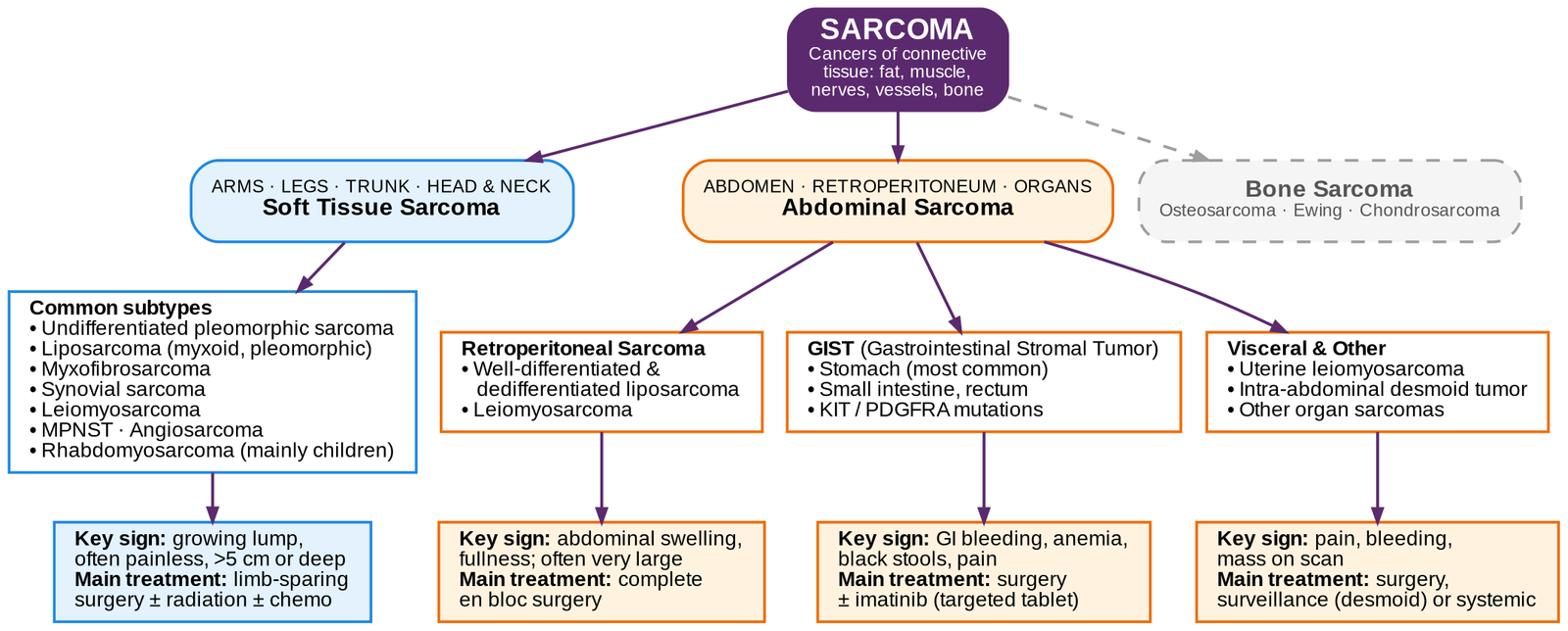
You may have been diagnosed with a soft tissue sarcoma in the arm, leg, trunk or head and neck; a retroperitoneal sarcoma deep in the back of the abdomen; a gastrointestinal stromal tumor (GIST) of the stomach or intestine; or another abdominal sarcoma, such as uterine leiomyosarcoma or a desmoid tumor.
Care from a specialist sarcoma team from the very first step, ideally before any biopsy or surgery, is associated with better outcomes. Our team includes surgical oncologists experienced in limb-sparing and complex abdominal surgery, medical oncologists, radiation oncologists, specialist sarcoma pathologists and radiologists, reconstructive surgeons, physiotherapists, and nutrition, psycho-oncology, fertility and palliative care support.
This page provides general information and is not a substitute for a consultation. Always discuss your individual situation with your treating specialist.
Many sarcomas can be cured, particularly when they are found before spreading and are completely removed by an experienced sarcoma surgical team.
Your chance of cure depends on:
What the evidence shows:
Sarcoma is a rare cancer that starts in the body's connective tissues, such as fat, muscle, tendons, nerves, blood vessels, cartilage or bone.
Soft tissue sarcomas of the limbs and trunk are usually found as a growing lump and treated with limb-sparing surgery and often radiation, while abdominal sarcomas grow silently deep in the abdomen and need complex abdominal surgery or, for GIST, targeted tablets.
Table 1. Soft tissue sarcoma vs abdominal sarcoma
| Feature | Soft Tissue Sarcoma (Limbs / Trunk) | Abdominal & Retroperitoneal Sarcoma |
|---|---|---|
| Where it occurs | Arms, legs (especially thigh), trunk wall, head and neck | Retroperitoneum (behind the abdominal organs), stomach, intestines, uterus and other organs |
| How it is usually found | A lump you can see or feel | Abdominal swelling, fullness, pain, GI bleeding, or by chance on a scan |
| Typical size at diagnosis | Often 5–10 cm | Often very large (over 15–20 cm for retroperitoneal sarcoma) |
| Common subtypes | Undifferentiated pleomorphic sarcoma, myxofibrosarcoma, liposarcoma, synovial sarcoma, leiomyosarcoma | Well-differentiated / dedifferentiated liposarcoma, leiomyosarcoma, GIST, desmoid tumor |
| Main treatment | Limb-sparing surgery ± radiation ± chemotherapy | Complete en bloc surgery (sometimes with nearby organs); imatinib-based targeted therapy for GIST |
| Main pattern of recurrence | Spread to the lungs (high-grade tumors) | Local recurrence in the abdomen (retroperitoneal liposarcoma); liver and abdominal lining (GIST) |
The main sarcoma groups are soft tissue sarcomas, abdominal sarcomas (including retroperitoneal sarcoma and GIST) and bone sarcomas, each containing many subtypes.
Table 2. Common sarcoma subtypes at a glance
| Subtype | Typical Location | Key Facts |
|---|---|---|
| Undifferentiated pleomorphic sarcoma (UPS) | Thigh, arm, trunk | One of the most common soft tissue sarcomas in adults; usually high grade |
| Liposarcoma | Thigh, retroperitoneum | Arises from fat cells; well-differentiated, dedifferentiated, myxoid and pleomorphic types behave very differently |
| Leiomyosarcoma | Retroperitoneum, uterus, large blood vessels, limbs | Arises from smooth muscle |
| Myxofibrosarcoma | Limbs of older adults | Tends to spread along tissue planes; wide surgical margins are important |
| Synovial sarcoma | Near joints in teenagers and young adults | Defined by an SS18 gene fusion; often sensitive to chemotherapy |
| Gastrointestinal stromal tumor (GIST) | Stomach, small intestine | Most common sarcoma of the digestive tract; usually driven by KIT or PDGFRA mutations |
| Desmoid tumor (aggressive fibromatosis) | Abdominal wall, abdomen, limbs | Does not spread to distant organs but can grow locally; often monitored first |
| Angiosarcoma | Skin of scalp, breast (after radiation), organs | Arises from blood vessels; can be aggressive |
| MPNST | Along nerves | Associated with neurofibromatosis type 1 (NF1) |
| Rhabdomyosarcoma | Head and neck, genitourinary tract, limbs | Most common soft tissue sarcoma in children |
Because sarcoma is rare and complex, international guidelines recommend that patients be diagnosed and treated at a specialist sarcoma center, which is associated with better surgical results and outcomes.
In most cases, the cause of sarcoma is unknown, and there is no good evidence that an injury causes sarcoma, although an injury may draw attention to a lump that was already there.
Most patients begin sarcoma treatment within about two to six weeks of diagnosis, a timeframe generally considered appropriate for expert imaging, biopsy, pathology review and treatment planning.
Table 3. Typical timeline from diagnosis to sarcoma treatment
| Step | What Happens | Typical Timeframe* |
|---|---|---|
| 1. Referral to sarcoma center | Review of history, examination, existing scans | Within 1–2 weeks of a suspicious scan |
| 2. Local imaging | MRI (limbs / trunk) or CT (abdomen / retroperitoneum) | Within 1–2 weeks |
| 3. Core needle biopsy | Image-guided biopsy planned by the sarcoma team | Within 1–2 weeks |
| 4. Pathology and molecular tests | Subtype, grade, gene tests (e.g. MDM2, KIT, SS18) | 1–3 weeks |
| 5. Staging scans | CT chest (and abdomen / pelvis as needed) | Alongside biopsy |
| 6. Tumor board discussion | Surgery, radiation and chemotherapy plan agreed | Within about 1 week of results |
| 7. Treatment begins | Surgery, pre-operative radiation, chemotherapy or imatinib | About 2–6 weeks from diagnosis |
*Timeframes vary with your sarcoma, test availability and personal circumstances.
A second opinion is a normal, widely accepted part of sarcoma care, and given the rarity of sarcoma, an expert review of your pathology and scans is often especially valuable.
A second opinion is especially useful when:
Bring these to your second-opinion appointment:
Five-year survival for sarcoma depends strongly on subtype, grade and stage, ranging from over 90% for localized GIST to around 15% for soft tissue sarcomas that have spread to distant organs.
Table 4. Approximate five-year relative survival by stage
| Sarcoma Type | Localized | Regional (nearby spread) | Distant (spread far) | All Stages |
|---|---|---|---|---|
| Soft tissue sarcoma (all sites) | ~81% | ~60% | ~16% | ~65% |
| Gastrointestinal stromal tumor (GIST) | ~95% | ~84% | ~55% | ~85% |
Source: rounded approximations of U.S. SEER / American Cancer Society five-year relative survival, for general education only. Retroperitoneal sarcoma outcomes are reported mainly from specialist center series and vary widely by subtype.
Sarcoma grade describes how aggressive the cancer cells look under the microscope, and it is one of the most important predictors of whether a sarcoma is likely to spread.
Table 5. Sarcoma grade (FNCLCC system) explained
| Grade | What It Means | Typical Implications |
|---|---|---|
| Grade 1 (low grade) | Cells look closer to normal; slow-growing | Low risk of spread; surgery alone is often enough |
| Grade 2 (intermediate) | Moderately abnormal cells | Intermediate risk; radiation is often added |
| Grade 3 (high grade) | Very abnormal, fast-dividing cells | Higher risk of spread to the lungs; radiation and sometimes chemotherapy considered |
Sarcoma stage combines the tumor's size, grade, lymph node involvement and distant spread, and it guides treatment and prognosis.
Table 6. Soft tissue sarcoma stages explained (limbs and trunk)
| Stage | General Meaning | Typical Treatment Approach |
|---|---|---|
| Stage I | Low-grade tumor of any size, no spread | Surgery with clear margins; radiation for selected cases |
| Stage II | Higher-grade tumor up to 5 cm, no spread | Surgery, usually with radiation |
| Stage III | Higher-grade tumor larger than 5 cm, no spread | Surgery with radiation; chemotherapy considered for selected high-risk tumors |
| Stage IV | Spread to lymph nodes or distant organs (most often the lungs) | Chemotherapy or targeted therapy; surgery or radiation to limited metastases in selected patients |
The risk that a GIST will come back after surgery is estimated from its size, its mitotic rate (how fast cells divide) and where it started, and this decides whether imatinib is recommended after surgery.
Table 7. GIST recurrence risk factors
| Factor | Lower Risk | Higher Risk |
|---|---|---|
| Tumor size | 2 cm or less to 5 cm | Over 5–10 cm |
| Mitotic rate | 5 or fewer per 5 mm² (or 50 high-power fields) | More than 5 per 5 mm² |
| Location | Stomach | Small intestine, rectum, other sites |
| Tumor rupture | Not ruptured | Ruptured before or during surgery |
Metastatic sarcoma can be treated, and some patients – particularly those with limited lung metastases or GIST – live for many years with treatment.
Prognosis in sarcoma is shaped mainly by the subtype, grade, size, depth and stage of the tumor and whether it can be completely removed.
The most common sign of soft tissue sarcoma is a painless lump that is growing, while abdominal sarcomas usually cause abdominal swelling, fullness, pain or bleeding from the digestive tract.
Table 8. Common symptoms by sarcoma type
| Sarcoma Type | Common Symptoms |
|---|---|
| Soft tissue sarcoma (limbs / trunk) | A lump that grows over weeks to months, usually painless; may cause pain, numbness or swelling if it presses on nerves or vessels |
| Retroperitoneal sarcoma | Abdominal swelling or a feeling of fullness, early satiety, vague back or abdominal pain, leg swelling, often no symptoms until very large |
| GIST | Black or bloody stools, vomiting blood, anemia and tiredness, abdominal pain, feeling full quickly, a mass |
| Uterine leiomyosarcoma | Abnormal vaginal bleeding, pelvic pain or pressure, a rapidly enlarging 'fibroid' |
| Desmoid tumor | A firm lump in the abdominal wall or limb; may cause pain or restrict movement |
Most lumps and abdominal symptoms are caused by non-cancerous conditions, but those with warning features should be assessed.
Most soft tissue lumps are benign lipomas, but a lump that is larger than 5 cm, growing, deep within the muscle, or has come back after removal should be checked with imaging before any surgery.
Table 9. Lipoma vs sarcoma: warning features
| Feature | More Typical of a Lipoma | Warning Sign – Seek Assessment |
|---|---|---|
| Size | Usually under 5 cm | Larger than 5 cm (about the size of a golf ball) |
| Growth | Usually stable for years | Growing over weeks or months |
| Depth | Just under the skin, soft and mobile | Deep, firm or fixed to underlying tissue |
| Pain | Usually painless | Often painless too – pain does not rule sarcoma out |
| After removal | Rarely comes back | Comes back after previous removal |
Important: A suspicious lump should be assessed with ultrasound or MRI and, if needed, a core needle biopsy at a sarcoma center before it is removed.
Abdominal and retroperitoneal sarcomas are often found late because the abdomen has room for tumors to grow very large before they press on organs or cause noticeable symptoms.
See a doctor promptly for any lump that is growing, larger than 5 cm or deep, and seek emergency care for signs of internal bleeding or severe abdominal pain.
Table 10. How urgently to seek care
| Symptom | Action |
|---|---|
| Vomiting blood, or black / tarry stools with dizziness | Go to emergency care |
| Severe or sudden abdominal pain | Go to emergency care |
| Sudden painful swelling of a known lump or a limb | Seek same-day medical care |
| New numbness or weakness in a limb near a lump | Seek same-day medical care |
| A lump larger than 5 cm, growing, or deep | Book a doctor's appointment and request imaging |
| A lump that has returned after removal | Book a doctor's appointment |
| Persistent abdominal fullness or swelling | Book a doctor's appointment |
Sarcoma is diagnosed with imaging followed by an image-guided core needle biopsy reviewed by a specialist sarcoma pathologist, with scans of the chest to check for spread.
Table 11. Diagnostic and staging tests for sarcoma
| Test | Purpose |
|---|---|
| Ultrasound | First assessment of a lump; guides biopsy |
| MRI with contrast | Preferred scan for limb and trunk sarcomas; shows size, depth and relationship to nerves and vessels |
| CT scan of abdomen and pelvis | Preferred scan for retroperitoneal and abdominal sarcomas |
| CT scan of the chest | Checks for lung metastases, the most common site of spread |
| Image-guided core needle biopsy | Obtains tissue to confirm subtype and grade; planned by the sarcoma team |
| Upper endoscopy / endoscopic ultrasound | Diagnoses and samples GISTs in the stomach |
| PET-CT | Used selectively, e.g. for staging some high-grade sarcomas or monitoring GIST response |
| Whole-spine or whole-body MRI | For subtypes that may spread to the spine or soft tissues, such as myxoid liposarcoma |
| Molecular / genetic testing | Confirms subtype and identifies targetable mutations |
A sarcoma biopsy should be planned by the treating sarcoma team because the needle path may need to be removed at surgery; when done correctly, the risk of spreading cancer is very low.
Table 12. What to expect on the day of a biopsy
| Procedure | Anesthesia | Procedure Time | Usually Home |
|---|---|---|---|
| Ultrasound- or CT-guided core needle biopsy (limb / trunk) | Local anesthetic | 20–45 minutes | Same day, often within 1–2 hours |
| CT-guided biopsy of abdominal / retroperitoneal mass | Local anesthetic ± mild sedation | 30–60 minutes | Same day, after observation |
| Endoscopic ultrasound biopsy (GIST) | Sedation | 30–60 minutes | Same day |
After your biopsy:
Molecular testing identifies the gene changes that define many sarcoma subtypes, confirming the diagnosis and, in some cases, pointing to targeted treatments.
Table 13. Examples of molecular markers in sarcoma
| Marker | Sarcoma Subtype | Why It Matters |
|---|---|---|
| MDM2 amplification | Well-differentiated / dedifferentiated liposarcoma | Helps confirm the diagnosis and distinguish it from a benign lipoma |
| KIT or PDGFRA mutation | GIST | Predicts response to imatinib and guides dose or drug choice |
| SS18 fusion | Synovial sarcoma | Helps confirm the diagnosis |
| DDIT3 fusion | Myxoid liposarcoma | Confirms diagnosis; this subtype is often radiation-sensitive |
| NTRK fusion | Rare sarcomas | Eligibility for NTRK inhibitors |
| ALK rearrangement | Inflammatory myofibroblastic tumor | Eligibility for ALK inhibitors |
| SDH deficiency | Some GISTs (often younger patients) | Usually less responsive to imatinib; may indicate inherited syndrome |
| CTNNB1 mutation | Desmoid tumor | Supports diagnosis; absence may prompt testing for FAP |
Availability of targeted drugs varies by country.
Sarcoma biopsy results usually take about 1 to 2 weeks because specialised stains and expert review are often needed, and molecular tests can take 2 to 3 weeks.
Table 14. Typical test result turnaround times
| Test | Typical Turnaround* |
|---|---|
| MRI / CT report | Same day to 2 days |
| Core biopsy – initial pathology | 5–7 working days |
| Immunohistochemistry and expert sarcoma review | Adds 3–7 working days |
| FISH / PCR molecular tests (e.g. MDM2, SS18) | 1–2 weeks |
| Next-generation sequencing (NGS) | 2–3 weeks |
| Germline (inherited) genetic testing | 2–4 weeks |
*Turnaround times vary between laboratories.
The most suitable sarcoma treatment depends on the subtype, grade, size and location of the tumor, and is planned by a multidisciplinary sarcoma tumor board.
Table 15. Main treatments by sarcoma type
| Sarcoma Type | Localized Disease | Advanced / Metastatic Disease |
|---|---|---|
| Limb / trunk soft tissue sarcoma | Wide excision (limb-sparing surgery), with radiation before or after for most intermediate- and high-grade tumors; chemotherapy for selected high-risk tumors | Chemotherapy (e.g. doxorubicin-based), subtype-specific drugs, surgery or SBRT for limited metastases |
| Retroperitoneal sarcoma | Complete en bloc surgical resection, often with nearby organs, at a specialist center; pre-operative radiation in selected cases | Chemotherapy, trabectedin or eribulin (liposarcoma), clinical trials |
| GIST | Surgery; imatinib for 3 years after surgery if high risk; imatinib before surgery to shrink large tumors | Imatinib, then sunitinib, regorafenib, ripretinib; avapritinib for PDGFRA D842V |
| Desmoid tumor | Active surveillance first in many cases; medical therapy or surgery if growing or symptomatic | Nirogacestat, sorafenib, low-dose chemotherapy |
| Uterine leiomyosarcoma | Hysterectomy | Chemotherapy, hormone therapy for selected cases |
Table 16. How long does sarcoma treatment take? Typical pathways
| Treatment Pathway | What It Involves | Approximate Total Duration* |
|---|---|---|
| Low-grade limb / trunk sarcoma | Surgery alone (radiation for selected cases) | About 1–3 months including recovery |
| High-grade limb sarcoma – radiation before surgery | 5 weeks of radiation, 4–6 week gap, surgery and wound healing | About 4–6 months |
| High-grade limb sarcoma – radiation after surgery | Surgery, 4–8 weeks of healing, 6–7 weeks of radiation | About 4–5 months |
| High-risk sarcoma with chemotherapy added | 3–5 cycles of chemotherapy plus surgery and radiation | About 6–9 months |
| Retroperitoneal sarcoma | Major surgery (± pre-operative radiation) | About 3–6 months including recovery |
| High-risk GIST | Surgery, then imatinib tablets | About 3 years (imatinib phase) |
| Metastatic GIST | Imatinib and later-line tablets | Ongoing while effective |
*Durations are typical examples and vary with response, wound healing and individual plans.
Most patients with limb sarcoma do not need amputation; limb-sparing surgery, usually combined with radiation, is possible for the large majority of patients, with cancer control comparable to amputation in published studies.
Sarcoma surgery aims to remove the whole tumor with a layer of healthy tissue around it (a wide margin), which is associated with a lower risk of local recurrence.
Table 17. Types of sarcoma surgery
| Procedure | What Is Done | Commonly Used For |
|---|---|---|
| Wide local excision | Tumor removed with a margin of healthy tissue and the biopsy tract | Most limb and trunk sarcomas |
| Compartmental / radical resection | Removal of the tumor with surrounding muscle group | Larger or infiltrative tumors |
| Limb-sparing surgery with reconstruction | Tumor removal plus flaps, grafts or vessel / nerve reconstruction | Tumors near critical structures |
| En bloc retroperitoneal resection | Tumor removed in one piece with adjacent organs if involved (e.g. kidney, colon) | Retroperitoneal sarcoma |
| Wedge or segmental resection | Removal of the GIST with a rim of stomach or bowel; often laparoscopic | GIST |
| Metastasectomy | Removal of limited lung metastases, often by keyhole (VATS) surgery | Selected metastatic sarcoma |
| Amputation | Removal of part of a limb | When limb-sparing surgery is not possible |
Table 18. Preparing for sarcoma surgery: timeline checklist
| When | What to Do* |
|---|---|
| As soon as surgery is planned | Stop smoking (it slows wound healing); stay active; meet the physiotherapist if limb surgery is planned |
| 2–3 weeks before | Pre-operative assessment: blood tests, ECG, anesthesia review; discuss reconstruction if needed |
| About 5–7 days before | Stop or adjust blood thinners, certain diabetes or herbal medicines – only as instructed |
| Night before | Fast as instructed (usually no food for 6 hours; clear fluids until 2 hours before); bowel preparation if advised for abdominal surgery |
| Day of surgery | Bring your medicines list, scans and reports; arrange help at home and transport on discharge |
*Always follow your own surgical team's instructions, which may differ.
Table 19. Typical hospital stay and recovery after sarcoma surgery
| Surgery | Hospital Stay* | Drains | Return to Desk Work* | Full Recovery* |
|---|---|---|---|---|
| Wide excision of limb / trunk sarcoma | 2–5 days | 1–2 weeks | 4–8 weeks | 2–3 months |
| Limb-sparing surgery with flap reconstruction | 5–10 days | 1–3 weeks | 6–12 weeks | 3–6 months |
| Retroperitoneal sarcoma resection | 7–14 days | Varies | 2–3 months | 3–6 months |
| Laparoscopic GIST resection | 2–4 days | Usually none | 2–4 weeks | 4–6 weeks |
| Amputation | 5–14 days | Varies | 2–3 months | 6–12 months with prosthetic rehabilitation |
*Recovery varies with the extent of surgery, wound healing (especially after radiation), fitness and any complications.
Radiation therapy is commonly recommended for intermediate- and high-grade limb and trunk sarcomas to lower the risk of the tumor returning, and it is increasingly given before surgery.
Table 20. Radiation before vs after sarcoma surgery
| Feature | Pre-operative Radiation | Post-operative Radiation |
|---|---|---|
| Typical dose and schedule | About 50 Gy in 25 daily sessions over 5 weeks | About 60–66 Gy in 30–33 daily sessions over 6–7 weeks |
| Surgery timing | About 4–6 weeks after radiation ends | Radiation starts about 4–8 weeks after wound healing |
| Wound complications | Higher risk of wound-healing problems | Lower risk of wound problems |
| Long-term effects | Less long-term stiffness, fibrosis and swelling | More long-term stiffness, fibrosis and swelling |
| Treatment area | Smaller, more precise field | Larger field covering the surgical bed |
Table 21. Your radiation therapy journey step by step
| Step | What Happens | Typical Timing* |
|---|---|---|
| Consultation | Radiation oncologist explains benefits, side effects and schedule | After tumor board |
| Planning scan (simulation) | CT or MRI in treatment position; a mould may be made to keep the limb still | About 30–60 minutes |
| Treatment planning | Physicists and doctors design the radiation plan | About 1–2 weeks |
| Daily treatment | Short sessions, Monday to Friday | 5 weeks (before surgery) or 6–7 weeks (after surgery) |
| Weekly review | Check of skin, side effects and wellbeing | Once a week |
| Skin reaction peak | Redness and soreness are often worst near the end | Up to about 1–2 weeks after the last session |
| Surgery (if radiation given first) | Operation once tissues have recovered | About 4–6 weeks after radiation |
*Timings vary between centers and patients.
Chemotherapy is not needed for every sarcoma; it is mainly used for high-risk localized tumors, chemotherapy-sensitive subtypes and metastatic disease.
Table 22. Common systemic treatment schedules for sarcoma
| Treatment | Used For | How Often | Typical Course | Setting / Time per Visit |
|---|---|---|---|---|
| Doxorubicin ± ifosfamide | High-risk or metastatic soft tissue sarcoma | Every 3 weeks | 3–6 cycles | Day care (doxorubicin); 3–5 day hospital stay with ifosfamide |
| Gemcitabine + docetaxel | Leiomyosarcoma, UPS and others | Days 1 and 8, every 3 weeks | Until progression or side effects | Day care; about 2–3 hours |
| Trabectedin | Liposarcoma, leiomyosarcoma | Every 3 weeks | As long as effective | 24-hour infusion via a central line |
| Eribulin | Liposarcoma | Days 1 and 8, every 3 weeks | As long as effective | Day care; short infusion |
| Imatinib | GIST | Daily tablet with food | 3 years after surgery (high risk); long-term in metastatic disease | At home; review every 1–3 months |
| Pazopanib | Non-fat-derived soft tissue sarcomas | Daily tablet | As long as effective | At home; regular blood and blood pressure checks |
Table 23. A typical 3-week doxorubicin / ifosfamide chemotherapy cycle
| Day of Cycle | What Usually Happens* |
|---|---|
| Day 1–3 (or 1–5) | Chemotherapy given in hospital with fluids and mesna; anti-nausea medicines |
| Day 2–5 | Nausea and tiredness most likely; growth factor injection often given |
| Day 7–14 | Blood counts at their lowest – highest infection risk; check temperature if unwell |
| Day 14–21 | Energy and blood counts recover |
| Day 21 | Blood tests and review before the next cycle |
*Patterns vary with the regimen and individual response.
Schedules are typical examples. Regimens and drug availability vary by country and individual circumstances.
Retroperitoneal sarcoma is primarily treated with complete surgical removal in one piece (en bloc), often with nearby organs, by a high-volume specialist sarcoma team.
GIST (gastrointestinal stromal tumor) is the most common sarcoma of the digestive tract, and most GISTs respond to imatinib, a daily targeted tablet that has substantially improved outcomes.
Table 24. Typical imatinib use in GIST
| Situation | How Imatinib Is Used | Typical Duration* |
|---|---|---|
| Low-risk GIST after surgery | Usually not needed | None |
| High-risk GIST after surgery (adjuvant) | 400 mg daily to lower recurrence risk | 3 years (longer in some cases or trials) |
| Large GIST before surgery (neoadjuvant) | To shrink the tumor and allow smaller surgery | Usually 6–12 months, until maximum response |
| Metastatic or inoperable GIST | To control disease | Long-term, as long as effective; stopping is generally not advised |
| KIT exon 9 mutation | Higher dose (800 mg daily) often used in advanced disease | As above |
| PDGFRA D842V mutation | Imatinib not effective; avapritinib used instead | As long as effective |
Table 25. Typical monitoring while taking imatinib
| What Is Checked | First 3 Months* | After 3 Months* |
|---|---|---|
| Clinic review and side effects | Every 2–4 weeks | Every 2–3 months |
| Blood counts and liver / kidney tests | Every 2–4 weeks | Every 2–3 months |
| CT scan (metastatic or neoadjuvant use) | Around 3 months | Every 3–6 months |
| CT scan (adjuvant use after surgery) | – | Every 3–6 months during treatment |
*Durations and monitoring intervals are typical; your oncologist will tailor them to you.
A desmoid tumor is a locally aggressive soft tissue tumor that typically does not spread (metastasize) to other organs, and many desmoid tumors are first managed with active surveillance rather than immediate surgery.
Targeted therapy is a standard treatment for GIST and several rare sarcoma subtypes, while immunotherapy benefits only selected subtypes and is often offered within clinical trials.
Table 26. Examples of targeted and immune-based therapies in sarcoma
| Therapy | Sarcoma Subtype |
|---|---|
| Imatinib, sunitinib, regorafenib, ripretinib, avapritinib | GIST |
| Pazopanib | Non-adipocytic soft tissue sarcoma |
| Nirogacestat | Desmoid tumor |
| Tazemetostat | Epithelioid sarcoma |
| Larotrectinib, entrectinib | NTRK fusion-positive sarcomas |
| Crizotinib | ALK-positive inflammatory myofibroblastic tumor |
| Sirolimus-based therapy | PEComa |
| Atezolizumab and other immune checkpoint inhibitors | Alveolar soft part sarcoma; selected UPS, angiosarcoma (trials) |
| Engineered T-cell therapy (afamitresgene autoleucel) | Selected MAGE-A4-positive synovial sarcoma |
Approvals and availability vary by country. Your oncologist will advise which options apply to your subtype.
A sarcoma tumor board is a meeting where sarcoma specialists from each relevant field review your case together to agree on a recommended treatment plan.
Because sarcoma is rare, clinical trials play an especially important role, and they may be a suitable option at many stages of the disease.
Side effects depend on the treatment you receive; many are temporary, and most can be reduced with modern supportive care and rehabilitation.
Table 27. Common side effects and how they are managed
| Treatment | Common Side Effects | How They Are Managed |
|---|---|---|
| Limb surgery | Pain, wound healing problems, fluid collection (seroma), stiffness, weakness, numbness | Drains, wound care, physiotherapy, occupational therapy |
| Abdominal / retroperitoneal surgery | Pain, slow bowel recovery, fatigue, effects of organ removal | Enhanced recovery (ERAS) protocols, nutrition support |
| Radiation | Skin redness, fatigue, later stiffness, swelling (lymphedema), rarely bone fracture | Skin care, stretching, compression, physiotherapy |
| Doxorubicin | Hair loss, nausea, low blood counts, mouth sores, long-term heart effects | Anti-nausea medicines, growth factors, heart monitoring (echo) |
| Ifosfamide | Kidney and bladder irritation, confusion, fatigue | Mesna and fluids given with treatment, blood tests |
| Imatinib | Puffy eyes, fluid retention, muscle cramps, nausea, diarrhea, rash, fatigue, anemia | Take with food, diuretics if needed, dose adjustments |
| Pazopanib | High blood pressure, diarrhea, liver changes, hair color change | Blood pressure and liver monitoring |
Many patients regain good function after limb-sparing sarcoma surgery, especially with early, structured physiotherapy, although the degree of recovery depends on the muscles, nerves and bones involved.
Contact your oncology team immediately, day or night, if you develop a temperature of 38°C (100.4°F) or above during chemotherapy, as this may signal a serious infection.
Table 28. When to contact your care team
| Symptom | Threshold | Action |
|---|---|---|
| Fever or chills | 38.0°C (100.4°F) or above, or shivering | Call immediately / go to emergency |
| Wound problems | Redness, heat, pus, opening of the wound or rapidly increasing swelling | Call the same day |
| Confusion, drowsiness or hallucinations (on ifosfamide) | Any new episode | Call immediately |
| Blood in urine (on ifosfamide) | Any visible blood | Call immediately |
| Black stools or vomiting blood (GIST) | Any episode | Go to emergency care |
| Breathlessness, chest pain or palpitations | New or sudden | Go to emergency care |
| Leg pain or swelling | One leg red, painful or swollen | Call the same day (possible blood clot) |
| Diarrhea | More than 4–6 episodes a day above normal | Call the same day |
Follow any specific thresholds your own team gives you. +91 88840 09955
Rehabilitation is an important part of sarcoma recovery, helping you regain strength, movement and independence after surgery and radiation.
Table 29. Typical rehabilitation milestones after limb-sparing surgery
| Milestone | Typical Timing* |
|---|---|
| Start of gentle movement and walking | Day 1–3 after surgery |
| Drain removal | 1–2 weeks |
| Wound healing and stitch removal | 2–3 weeks (longer after radiation) |
| Start of radiation (if after surgery) | About 4–8 weeks |
| Return to driving | Usually 4–8 weeks for leg surgery, when safe to brake |
| Return to most daily activities | 2–3 months |
| Maximum functional recovery | 6–12 months |
*Milestones vary with tumor location, extent of surgery and radiation.
Some sarcoma treatments, particularly ifosfamide, doxorubicin-based chemotherapy and pelvic radiation, can affect fertility, so fertility preservation should be discussed before treatment starts.
Most people are encouraged to stay as active as their surgery and treatment allow and to eat a balanced, protein-rich diet to support healing.
Many people continue working during parts of sarcoma treatment, often with adjusted hours, although time off is usually needed after surgery.
Table 30. Planning work around sarcoma treatment
| Treatment Phase | Typical Impact on Work* |
|---|---|
| Wide excision of limb / trunk sarcoma | 4–8 weeks off (longer for physical jobs) |
| Retroperitoneal sarcoma surgery | 2–3 months off |
| Daily radiation (5–7 weeks) | Daily visits; fatigue builds toward the end; many reduce hours |
| Doxorubicin / ifosfamide chemotherapy | Often significant fatigue; many take time off |
| Imatinib or other tablets | Most people can work normally |
*Individual experiences vary.
Most sarcomas have no identifiable cause, but known risk factors include previous radiation therapy, certain inherited syndromes, chronic lymphedema and some chemical exposures.
Table 31. Known sarcoma risk factors
| Risk Factor | Associated Sarcomas |
|---|---|
| Previous radiation therapy (usually 10 or more years earlier) | Radiation-associated sarcoma, angiosarcoma (e.g. after breast cancer radiation) |
| Chronic lymphedema | Lymphangiosarcoma (Stewart–Treves syndrome) |
| Vinyl chloride, arsenic, thorium dioxide | Angiosarcoma of the liver |
| Human herpesvirus 8 with weakened immunity | Kaposi sarcoma |
| Inherited syndromes | See table below |
Most sarcomas are not inherited, but a small proportion are linked to inherited syndromes, and genetic counselling is recommended when sarcoma occurs at a young age or alongside other cancers in the family.
Table 32. Inherited syndromes linked to sarcoma
| Syndrome (Gene) | Associated Sarcomas | Other Associated Cancers |
|---|---|---|
| Li-Fraumeni syndrome (TP53) | Soft tissue sarcoma, osteosarcoma | Breast, brain, adrenal, leukemia |
| Neurofibromatosis type 1 (NF1) | MPNST, GIST | Brain tumors, breast |
| Hereditary retinoblastoma (RB1) | Osteosarcoma, soft tissue sarcoma | Retinoblastoma |
| Familial adenomatous polyposis (APC) | Desmoid tumor | Colorectal cancer |
| SDH-deficient syndromes (SDHx) | GIST | Paraganglioma, pheochromocytoma |
| Familial GIST (KIT / PDGFRA germline) | Multiple GISTs | – |
There is no screening test for sarcoma in the general population, and because most sarcomas have no known cause, prevention is generally not possible.
Recurrence risk depends mainly on the grade, size, subtype and location of the sarcoma and whether it was completely removed; most recurrences happen within the first two to three years.
Sarcoma follow-up involves regular examinations and scans of the original site and chest, most frequently in the first two to three years after treatment.
Table 33. Typical follow-up schedule after sarcoma treatment
| Time Since Treatment | High-Grade Soft Tissue Sarcoma | Low-Grade / Retroperitoneal / GIST |
|---|---|---|
| Years 1–3 | Every 3–4 months: examination, MRI of the original site as indicated, chest CT or X-ray | Every 4–6 months: examination and CT (abdomen ± chest) |
| Years 4–5 | Every 6 months | Every 6 months |
| After 5 years | Once a year | Once a year, often continued long term for retroperitoneal sarcoma |
Recurrent or metastatic sarcoma can often still be treated, and in selected patients further surgery or radiation may provide long-term control.
Feeling isolated, anxious or overwhelmed after a sarcoma diagnosis is common and understandable, and emotional support is an important part of sarcoma care.
The cost of sarcoma treatment varies widely with the type of surgery, reconstruction, radiation and drugs used, and many health insurance plans cover a large part of it.
Table 34. Cost estimate overview (to be completed by hospital)
| Treatment | Estimated Cost Range | Typically Covered by Insurance? |
|---|---|---|
| Wide excision of limb / trunk sarcoma | [range] | [Yes / Partial] |
| Limb-sparing surgery with reconstruction | [range] | [ ] |
| Retroperitoneal sarcoma resection | [range] | [ ] |
| Radiation therapy (full course) | [range] | [ ] |
| Chemotherapy (per cycle) | [range] | [ ] |
| Imatinib / targeted therapy (per month) | [range] | [ ] |
Preparing a list of questions before your first appointment helps you understand your sarcoma diagnosis and take an active part in treatment decisions.
Table 35. What to bring to your first appointment
| Item | Why It Helps |
|---|---|
| Referral letter and prior consultation notes | Gives the team your full history |
| MRI / CT images (CD or link) and reports | Avoids unnecessary repeat scans |
| Biopsy or surgical pathology report and tissue blocks / slides | Allows expert sarcoma pathology review |
| Operation notes (if a lump was already removed) | Helps plan any further surgery |
| List of current medicines and allergies | Helps your team avoid drug interactions and allergic reactions |
| Insurance card and ID | Speeds up registration and pre-authorisation |
| A family member or friend | Helps with listening, notes and support |
At Aster Whitefield Hospital, patients with sarcoma can access:
Book a consultation with a sarcoma specialist – ideally before any biopsy or surgery. Call +91 88840 09955 or /contact/ to schedule an appointment or request a second opinion.
Medical disclaimer – please note:
For a second opinion or to book an appointment, call +91 88840 09955, message us on WhatsApp, or use our Contact page.